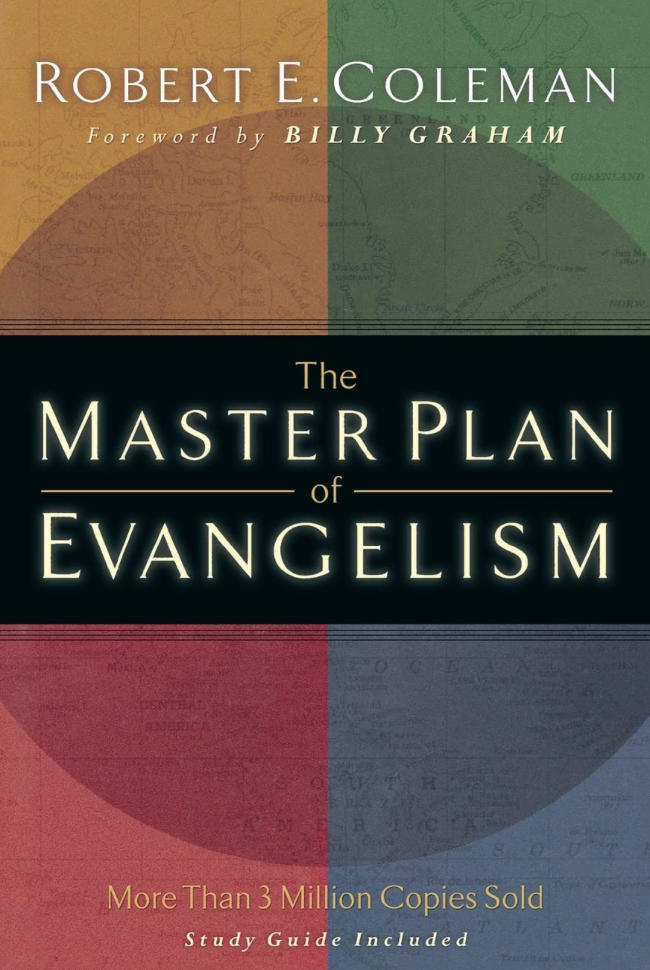
The Master Plan of Evangelism
By: Robert E. Coleman
ISBN: 978-0800731229
RATING: 10/10
Summary: This book is the gold-standard for Jesus-style disciplemaking. Despite being written over sixty years ago the principles it unfolds remain unchanged. Coleman’s to-the-point writing style make it an easy read that has tremendous focus on what’s important. What makes this book unique is that it’s hyper-focused on Jesus’ life and what He did. It also challenges the reader to respond with action. This pairing is a huge part of why this book has stood the test of time…and will continue to do so. If you’re a disciple maker you owe it to yourself to have and to reread this book!
Chapter titles are: Foreword, Introduction, Preface, 1. Selection 2. Association 3. Consecration 4. Impartation 5. Demonstration 6. Delegation 7. Supervision 8. Reproduction, Epilogue, Notes, Study Guide
Introduction:
“It is the conviction, grounded in the good news that ‘God was in Christ, reconciling the world unto Himself,’ that makes evangelism immensely more than a theory or a slogan.” Pg. 11
Preface:
“Merely because we are busy, or even skilled, doing something does not necessarily mean that we are getting anything accomplished.” Pg. 13
“Do we see an ever-expanding company of dedicated people reaching the world with the gospel as a result of our ministry?” pg. 13-14
“We must know how a course of action fits into the overall plan God has for our lives if it is to thrill our souls with a. sense of destiny.” Pg. 14
“His love was universal.” Pg. 17
“…There never was a distinction in his mind between home and foreign missions. To Jesus it was all world evangelism.” Pg. 17
“His life was ordered by his objective. Everything he did and said was a part of the whole pattern. It had significance because it contributed to the ultimate purpose of his life in redeeming the world for God. This was the motivating vision governing his behavior. His steps were ordered by it. Mark it well. Not for one moment did Jesus lose sight of his goal.” Pg. 18
“There was nothing haphazard about his life—no wasted energy, not an idle word.” Pg. 18
“In fact, at first glance it might even appear that Jesus had no plan.” Pg. 18
“But when the realization of his controlling method finally dawns on the open mind of the disciple, he will be amazed at its simplicity and will wonder how he could have ever failed to see it before.” Pg. 18
“However, it must be said that the steps are not to be understood as invariably coming in this sequence…all of the steps were implied in each one, and in some degree they all began with the first.” Pg. 19
Chapter 1: Selection
“His concern was not with programs to reach the multitudes, but with men whom the multitudes would follow. Remarkable as it may seem, Jesus started to gather these men before he ever organized an evangelistic campaign or even preached a sermon in public. Men were to be his method of winning the world to God.” pg. 21
“For as it turned out, thee few early converts of the Lord were destined to become the leaders of his church that was to go with the gospel to the whole world, and from the standpoint of his ultimate purpose, the significance of their lives would be felt throughout eternity. That’s the only thing that counts.” Pg. 22
“They were indeed ‘unlearned and ignorant’ according to the world’s standard (Acts 4:13), but they were teachable.” Pg. 23
“The necessity is apparent not only to select a few helpers but also to keep the group small enough to be able to work effectively with them.” pg. 24
“…Peter, James, and John seemed to enjoy a more special relationship to the Master than did the other nine.” Pg. 24
“The fact that there is no record of the disciples complaining about the preeminence of the three, though they did murmur about other things, is proof that where preference is shown in the right spirit and for the right reason offense need not arise.” Pg. 25
“All of this certainly impresses on with the deliberate way that Jesus proportioned his life to those he wanted to train. It also graphically illustrates a fundamental principle of teaching: that other things being equal, the more concentrated the size of the group being taught, the greater the opportunity for effective instruction.” Pg. 25
“Jesus devoted most of his remaining life on earth to these few disciples. He literally staked his whole ministry on them.” pg. 25
“Had Jesus given any encouragement to this popular sentiment among the masses, he easily could have had all the kingdoms of the world at his feet.” Pg. 26-27
“Why did Jesus deliberately concentrate his life on comparatively so few people?” pg. 28
“Jesus was not trying to impress the crowd, but to usher in a kingdom. This meant that he needed people who could lead the masses.” Pg. 28
“For this reason, unless Jesus’ converts were given competent men of God to lead them on and protect them in the truth they would soon fall into confusion and despair, and the last state would be worse than the first.” Pg. 29
“…the first duty of church leadership is to see to it that a foundation is laid in the beginning on which can be built an effective and continuing evangelistic ministry to the multitudes….It will mean raising up trained disciplers—‘for the work of ministering’ with the pastor and church staff (Eph. 4:12).” Pg. 30
“This principle of selectivity and concentration is engraved in the universe, and will bring results no matter who practices it, whether or not the church believes it.” Pg. 30-31
“In an age when facilities for rapid communication of the gospel are available to the church as never before, there are actually more unevangelized people on the earth today than before the invention of the horseless carriage.” Pg. 31
Chapter 2: Association
“Jesus had no formal school, no seminaries, no outlined course of study, no periodic membership classes in which he enrolled his followers.” Pg. 33
“He was his own school and curriculum.” Pg. 33
“Knowledge was gained by association before it was understood by explanation.” Pg. 34
“One living sermon is worth a hundred explanations.” Pg. 34
“…Jesus felt the need to get alone with his disciples.” Pg. 36
“Is not this the way it is with every family as the hour of departing draws near? Every minute is cherished because of the growing realization that such close association in the flesh will soon be no more.” Pg. 36
“He actually spent more time with his disciples than with everybody else in the world put together.” Pg. 37
“They were his spiritual children ( Mark 10:24; John 13:33, 21:5), and the only way that a father can properly raise a family is to be with it.” Pg. 38
“Nothing is more obvious yet more neglected than the application of this principle.” Pg. 38
“In such a way many attached themselves to the apostolic company, as is evidenced by the seventy with him in the later Judean ministry (Luke 10:1, 17).” Pg. 39
“…he had to devote himself primarily to the task of developing some leaders who in turn could give this kind of personal attention to others.” Pg. 39
“Really the whole problem of giving personal care to every believer is only resolved in a thorough understanding of the nature and mission of the church.” Pg. 40
“Nor can occasional prayer meetings and training classes for Christian workers do this job. Building men and women is not that easy. It requires constant personal attention, much like a father gives to his children. This is something that no organization or class can ever do. Children are not raised by proxy. The example of Jesus would teach us that it can be done only by persons staying close to those whom they seek to lead.” Pg. 40
“Of course, most churches insist on bringing new members through some kind of a confirmation class which usually meets an hour a week for a month or so.” Pg. 41
“There is simply no substitute for getting with people.” pg. 41
“This means that some system must be found whereby every convert is given a Christian friend to follow until such time as he or she can lead another. The counselor should stay with the new believer as much as possible, studying the Bible and praying with him or her, all the while answering questions, clarifying the truth, and seeking together to help others. If a church does not have such committed counselors willing to do this service, then it should be training some. And the only way they can be trained is by giving them a leader to follow.” Pg. 42
This is BIG. Well stated on the need and the point that they can only be trained is by experiencing it. The use of the word counselor is odd here, but Coleman clearly means a disciple maker—functioning like Jesus did with his men.
Chapter 3: Consecration
“Jesus expected the men he was with to obey him. They were not required to be smart, but they had to be loyal.” Pg. 43
“None of the disciples was asked at first to make a statement of faith or accept a well-defined creed, although they doubtless recognized Jesus to be the Messiah (John 1:41, 45, 49; Luke 5:8).” Pg. 44
“Following Jesus seemed easy enough at first, but that was because they had not followed him very far. It soon became more apparent that being a disciple of Christ involved far more than a joyful acceptance of the Messianic promise: it mean the surrender of one’s whole life to the Master in absolute submission to his sovereignty.” Pg. 44
“There had to be a complete forsaking of sin.” Pg. 44
“He was training leaders for the Kingdom and if they were going ot be fit vessels of service, they were going to have to pay the price.” Pg. 45
“Jesus did not have the time nor the desire to scatter himself on those who wanted to make their own terms of discipleship.” Pg. 46
“Indeed these words of the apostle must have been reassuring to the Master, for thereafter Jesus began to talk with his disciples more about his suffering and death.” Pg. 46
“Not comprehending clearly the message of the cross, of course, they faltered at first in understanding their own place in the Kingdom.” Pg. 47
“Jesus patiently endured these human failings of his chosen disciples, because in spite of all their shortcomings they were willing to follow him.” Pg. 47
“Obedience to Christ thus was the very means by which those in his company learned more truth.” Pg. 48
“Supreme obedience was interpreted to be the expression of love.” Pg. 48
“In his human nature he continually gave consent to the will of his Father which made it possible for God to use his life fully according to its intended purpose.” Pg. 49
“The cross was but the crowning climax of Jesus’ commitment to do the will of God. It forever showed that obedience could not be compromised—it was always a commitment unto death.” Pg. 49
“A father must teach his children to obey him if he expects his children to be like him.” Pg. 50
“We are engaged in warfare, the issues of life which are life and death, and every day that we are indifferent to our responsibilities is a day lost to the cause of Christ.” Pg. 51
“Unless there is a dedication to all that we know he wants us to do now, however immature our understanding may be, it is doubtful if we will ever progress further in his life and mission. There is no place in the Kingdom for a slacker, for such an attitude not only precludes any growth in grace and knowledge but also destroys any usefulness on the world battlefield of evangelism.” Pg. 51
“One must ask, why are so many professed Christians today stunted in their growth and ineffectual in their witness?” pg. 51
“Indeed, it would appear that the teachings of Christ regarding self-denial and dedication have been replaced by a sort of respectable “do as you please” philosophy of expediency.” Pg. 51
“It is high time that the requirements for membership in the church be interpreted and enforced in terms of true Christian discipleship.” Pg. 51
“…before much can be done with the church membership something will have to be done with the church officials.” Pg. 51
Chapter 4: Impartation
“Jesus wanted his followers to obey him.” Pg. 53
“The disciples understood that they were not just keeping the law, but were responding to the One who loved them, and was willing to give himself for them.” pg. 53
“Love is like that. It is always giving itself away.” Pg. 54
“God gave all he had to those he loved, even his ‘only begotten Son.” Pg. 54
“That is why he lost no opportunity to impress on his followers the deep compulsion of his own soul aflame with the love of God for a lost world.” Pg. 54
“They saw how their Master denied himself many of the comforts and pleasures of the world and became a servant among them.” pg. 54-55
“That is why he lost no opportunity to impress on his followers the deep compulsion of his own soul aflame with the love of God for a lost world.” Pg. 54
“They saw how their Master denied himself many of the comforts and pleasures of the world and became a servant among them.” pg. 55
“…it was clear that the Master considered no service too small nor sacrifice too great when it was rendered for the glory of God.” pg. 55
“His sanctification then was not for the purpose of benefitting himself, but it was for his disciples, that they might be ‘sanctified in truth.’” Pg. 55
“Love—Calvary love—was the standard.” Pg. 56
“Love is the only way to win the free response of men…” pg. 56
“It is only the Spirit of God who enables one to carry on the redemptive mission of evangelism.” Pg. 57
“Jesus was God in revelation; but the Spirit was God in operation.” Pg. 57
“…Jesus explained to his disciples that the Spirit would prepare the way for their ministry.” Pg. 57
“All the disciples were asked to do was to let the Spirit have complete charge of their lives.” Pg. 57
“Evangelism had to become a burning compulsion within them purifying their desires and guiding their thoughts.” Pg. 59
“It only serves to remind us of the mighty power of the Spirit of God accomplishing his purpose in disciples fully yielded to his control. After all, the power is in the Spirit of Christ. It is not who we are, but who he is that makes the difference.” Pg. 59
“We must have his life in us by the Spirit if we are to do his work and practice his teaching.” Pg. 60
“Of course, we cannot give something away which we do not possess ourselves.” Pg. 60
“But we cannot stop there. It is also necessary for on to see in us a clear demonstration of the way to live his life. Thus, we must understand another obvious aspect of Jesus’ strategy with his disciples.” Pg. 61
Chapter 5: Demonstration
“I have given you an example.” Pg. 63
“One thing is certain: unless they grasped the meaning of prayer, and learned how to practice it with consistency, not much would ever come from their lives.” Pg. 64
“Often he would take special pains to impress on his followers the meaning of some passage in the Bible, and he never ceased to use the Scriptures in his conversation with them. Altogether, there are at least sixty-six references to the Old Testament in his dialogues with the disciples in the four Gospels, to say nothing of the more than ninety allusions to it in his speaking with others.” Pg. 65
“…most important in view of his ultimate purpose was that all the while he was teaching them how to win souls.” Pg. 65
“Jesus was so much the Master in his teaching that he did not let his method obscure his lesson.” Pg. 66
“All the disciples had to teach them was a teacher who practiced with them what he expected them to learn.” Pg. 66
“They observed how he drew people to himself; how he won their confidence and inspired their faith; how he opened to them the way of salvation and called them to a decision.” Pg. 66
“The disciples were always there to observe his word and deed.” Pg. 67
“…because he loved his riches more than the Kingdom of God, Jesus turned to his disciples and said: ‘It is hard for a rich man to enter into the kingdom of heaven.’ (Matt. 19:23; see Mark 10:23; Luke 18:24). ‘The disciples were amazed at this words’ (Mark 10:24). This led to an extended conversation in which Jesus explained the reason for his approach to this good, moral man, while also using the opportunity to apply the principle to their own profession of faith (Mark 19:24-31; Matt. 19:24-20:16; Luke 18:25-30).” Pg. 67
“He did not ask anyone to do or be anything which first he had not demonstrated in his own life, thereby not only proving its workability, but also its relevance to his mission in life.” Pg. 68
“His training classes were never dismissed.” Pg. 68
“ …they were learning practically every moment of their waking day.” Pg. 68
“When it is all boiled down, those of us who are seeking to train people must be prepared to have them follow us, even as we follow Christ (1 Cor. 11:1). We are the exhibit (Phil. 3:17f; 1 Thess. 2:7, 8; 2 Tim. 1:13).” Pg. 68
“…mere knowledge is not enough.” Pg 69
“He was training men to do a job, and when they knew enough to get started, he saw to it that they did something about it.” Pg. 69
Chapter 6: Delegation
“He was never premature in his insistence on action. The first invitation ot the disciples to follow him said nothing about going out and evangelizing the world, although this was his plan from the beginning.” Pg. 71
-Although he did invite them to become fishers of men which is missional.
“…these early disciples really did not do much more than watch Jesus work for a year or more.” Pg. 72
“He first reaffirmed his purpose for their lives. They were to go and ‘preach the kingdom of God, and to heal the sick’ (Luke 9:1, 2; see Matt 10:1; Mark 6:7).” Pg. 73
“…Jesus was telling his disciples to go where they would find the most susceptible audience to hear their message.” Pg. 73
“In effect, the disciples were told to concentrate their time on the most promising individuals in each town who would thereby be able to follow up their work after they had gone.” Pg. 74
“This principle of establishing a beachhead in a new place of labor by connecting with a potentially key follow-up leader is not to be minimized.” Pg. 74
“No matter what happened to them, Jesus assured them that everyone who confessed him before men would be remembered before his Father in heaven (Matthew 10:32).” Pg. 75
“…Jesus reminded them of the decisive nature of the gospel invitation.” Pg. 75
“They were going forth with a revolutionary gospel, and when it was obeyed, it effected a revolutionary change in people and their society.” Pg. 76
“The point Jesus made in all these instructions was that the mission of his disciples was not different in principle or method from his own.” Pg. 76
“The point Jesus made in all these instructions was that the mission of his disciples was not different in principle or method from his own.” Pg. 76
“The disciples were to be the actual representatives of Christ as they went forth.” Pg. 76
“Doubtless this plan was intended to provide for his disciples’ needed companionship along the way.” Pg. 76
“So as the disciples went out, the Master likewise “departed thence to teach and preach in their cities” (Matthew 11:1). Pg. 77
“…the disciples were forerunners for their Lord, setting things up for his ministry.” Pg. 77
“Clearly Jesus did not leave the work of evangelism subject to human impression or convenience.” Pg. 79
“Christian disciples are sent men and women—sent out in the same work of world evangelism to which the Lord was sent, and for which he gave his life.” Pg. 79
“It is the heartbeat of all that we are called to be and do.” Pg. 79
“The best way to be sure that his is done is to give practical work assignments and expect them to be carried out.” Pg. 80
Chapter 7: Supervision
“In this sense, one might say that his teaching rotated between instruction and assignment.” Pg. 81
“…the initial solo excursion of the disciples was merely a field assignment as they continued their training with the Master.” Pg. 82
“…after the disciples were sent out to work, they were expected to share their experiences later with the group.” Pg. 82
“As he reviewed some experience which the disciples had, he would bring out some practical application of it to their lives.” Pg. 83
“…a much-needed lesson on how they, through more prayer and fasting, should have laid hold upon God’s faithfulness (Mark 9:17-29; Matt. 17:14-20; Luke 9:37-43).” Pg. 83
“…in connection with their attitude toward others in the work who were not members of the apostolic company.” Pg. 84
“The important thing about all this supervisionary work of Jesus was that he kept the disciples going on toward the goal he had set for them.” pg. 86
“His plan of teaching, by example, assignment, and constant checkup, was calculated to bring out the best that was in them.” pg. 86
“We dare not assume that the work will be done merely because we have shown a willing worker how to do it, and then sent him or her out with a glowing expectation of results.” Pg. 86
“All too many times one has been brought to the place of service only to be discharged with no further training or inspiration. The result is that the activity becomes localized ina. Feverish round of excitement. There is no growth.” Pg. 87
“We fail, not because we do not try to do something, but because we let our little efforts become an excuse for not doing more.” Pg. 87
“We have not been called to hold the fort, but to storm the heights.” Pg. 87
Chapter 8: Reproduction
“Jesus intended for the disciples to produce his likeness in and through the church being gathered out of the world. Thus his ministry in the Spirit would be duplicated manyfold by his ministry in the lives of his disciples.” Pg. 89
“By this strategy the conquest of the world was only a matter of time and their faithfulness to his plan.” Pg. 89
“It was not going to be an easy conquest. Many would suffer persecution and martyrdom in the battle.” Pg. 90
“This incredible confidence in the future was based on his knowledge of those who worshiped him in the present.” Pg. 90
“However, we must not fail to see the direct relation between bearing witness of Christ and the ultimate victory over the world. One cannot come without the other.” Pg. 91
“‘Through their word,’ he expected others to believe in him (John 17:20).” Pg. 91
“His whole evangelistic strategy—indeed, the fulfillment of his very purpose in coming into the world, dying on the cross, and rising from the grave—depended on the faithfulness of his chosen disciples to this task. It did not matter how small the group was to start with so long as they reproduced and taught their disciples to reproduce.” Pg. 91
“Here was the acid test. Would his disciples carry on his work after he had gone?” pg. 91
“If the disciples failed to impart his Spirit and method to others who would keep this work going, then his ministry with them all these years would soon come to naught.” Pg. 92
“…Christ explained that the purpose of both the vine (himself) and the branches (believers in him) was to bear fruit.” Pg. 92
“A barren Christian is a contradiction. A tree is known by its fruit.” Pg. 92
“In fact, where fruit bearing is seen in its larger context of reproducing the Christ life in human personality, first in ourselves and then in others, practically everything which the Master said and did pointed to this principle.” Pg. 93
“Only as disciples were made could the other activities of the commission fulfill their purpose.” Pg. 93
“The only hope for the world is for laborers to go to the them with the gospel of salvation, and having won them to the Savior, not to leave them, but to work with them faithfully, patiently, painstakingly, until they become fruitful Christians savoring the world about them with the Redeemer’s love.” Pg. 94
“Here finally is where we must all evaluate the contribution that our life and witness is making to the supreme purpose of him who is the Savior of the world….Noe, it is not enough to rescue the perishing, though this is the imperative; nor is it sufficient to build up newborn babes in the faith of Christ, although this, too, is necessary if the firstfruit is to endure; in fact, it is not sufficient just to get them out winning souls, as commendable as this work may be. What really counts is the ultimate perpetuation of our work is the faithfulness with which our converts go and make leaders out of their converts not simply more followers.” Pg. 94
“The test of any work of evangelism is…with which the work continues in the next generation.” Pg. 95
“…how many Christians are actively winning souls and training them to win the multitudes.” Pg. 95
“The costly principles of leadership development and reproduction seem to have been submerged beneath the easier strategy of mass recruitment.” Pg. 96
“…unless the personal mission of the Master is vitally incorporated into the policy and fabric of all these plans, the church cannot function as she should.” Pg. 97
“It is not better methods, but better men and women who know their Redeemer from personal experience—man and women who see his vision and feel his passion for the world…” pg. 97
Epilogue
“Everyone of us then should be seeking some way to incorporate the wisdom of Jesus’ strategy into our own preferred method of evangelism.” Pg. 100
“Variety is in the very structure of the universe, and any method that God is pleased to use is a good method, though this does not include the possibility of improvement in our way of doing it.” Pg. 100
“Jesus’ life would teach us that finding and training people to reach people must have priority.” Pg. 100
“If we are to train people, we must work for them. We must seek them. We must win them. Above all, we must pray for them.” pg. 101
“The best work is always done with a few.” Pg. 101
“In response to this question, ‘If you were a pastor of a large church in a principal city, what would be your plan of action?’ Mr. Graham [Billy} replied, ‘I think one of the first things I would be to get a small group of eight or ten or twelve people around me that would meet a few hours a week and pay the price! It would cost them something in time and effort. I would share with them everything I have, over a period of years. Then I would actually have twelve ministers among the laypeople who in turn could take eight or ten or twelve more and teach them. I know one or two churches that are doing that, and it is revolutionizing the church. Christ, I think, set the pattern. He spent most of his time with twelve men. He didn’t spend it with a great crowd. In fact, every time he had a great crowd it seems ot me that there weren’t too many results. The great results, it seems to me, came in this personal interview and in the time he spent with his twelve.’ Here Mr. Graham is merely echoing the wisdom of Jesus’ method.” Pg. 103
“All of this is going to require a lot of supervision, both in the personal development of these people, and in their work with others.” Pg. 105
“Probably many of those we start out with will think it too much and fall by the way.” Pg. 107
“The world is desperately seeking someone to follow. That they will follow someone is certain, but will that person be one who knows the way of Christ…” pg. 108
—
Find this helpful? Want to grow as a disciple or disciple maker? Check out my books: The Bicycle Illustration and The Foundation of a Disciple Making Culture. Or my monthly Disciple-Making Briefing Too much to read? Check out my Podcast, “The Practitioners’ Podcast” for short, hyper focused disciple making episodes wherever you get podcasts!