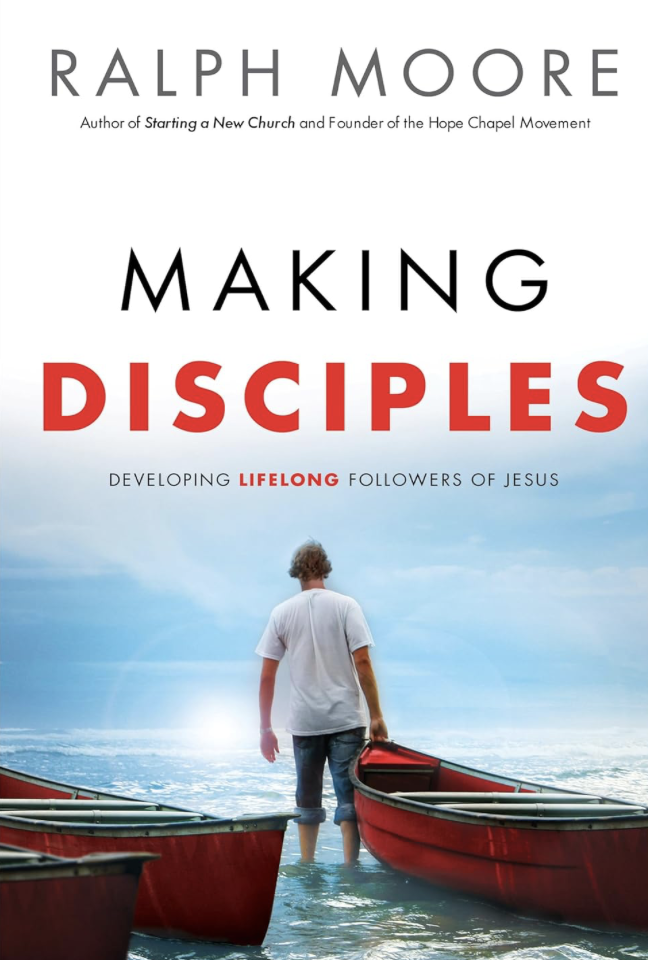
Making Disciples
By: Ralph Moore
ISBN: 978-0801018077
READ: March 2026
RATING: 5/10
Summary: Despite God using the author to catalyze powerful Kingdom fruit, I would not recommend this book to anyone seeking to develop a robust and nuanced understanding of making disciples. The book does a good job of elevating the value personal ministry—which is valuable. However, the de facto definition of disciple making the book holds to, “making an intentional investment in the spiritual life of someone else,” leaves much to be desired. Moore holds views on disciplemaking that I strongly disagree with such as: being able to disciple non-Christians, being able to disciple people without their knowledge (or even the discipler’s knowledge), calling those you disciple “my disciples,” basing important disciple making decisions on what’s more efficient, and the list goes on. Overall, the book has some solid practical advice, but it seems to be rooted in Moore’s experience as opposed to Jesus’ example or other Scriptural support. It’s not that this book is going to steer people in morally bad directions, but there are many, many disciple making books that do a better job anchoring the practice of disciple making in Scripture and practices that fit that anchoring.
More thoughts than usual in this booknotes. As usual my thoughts are in italics.
Chapter titles are: Foreword, Preface, Introduction 1. How a 16-Year-Old Taught Me Most of What I Know About Disciplemaking 2. Criticism I Well Deserve 3. What is Disicplemaking? 4. Every Christian is Called into the Great Commission 5. Disciplemaking as Process 6. Not “Just Another Program” 7. Who Should I Disicple? 8. Passing Along My Personal Legacy 9. The “How-To” Part 10. Fishing Pools All Around 11. Don’t Just Stand There, Do Something 12. Who Should Disciple Me? 13. What Do I Owe My Teacher? 14. What About Plain Old Friendship? 15. Problems You Will Encounter 16. Why Some Small Groups Won’t, Don’t, and Can’t Work 17. A Feedback Loop That Will Keep You Relevant 18. Good Things Do Come to an End
Preface:
“This book is written for ordinary Christians, as every believer is called to follow Christ and become ‘teachers of men.’”
“The whole point of the book is to establish what I call a “disciplemaking continuum,” where every element of a church is about turning Christ-followers into disciplemakers. At its heart, this book is a church health project.”
-This is the first of many times Moore uses the term “disciplemaking continuum.” After reading the book, I’ve concluded he doesn’t mean continuum which counts among its most common synonyms words such as: spectrum, scale, range, progression. What he means is something closer to culture. Unfortunately, such imprecision in communication is repeated throughout the book.
Introduction:
“This book is designed to change the way you live your everyday life—and to change it for the better. I’m hoping to teach you how to change the world one person at a time.” Pg. 13
“In any truly healthy church, most people will mature into strong local church leaders.” Pg. 12
-I’ve yet to see a church where most of the people are strong local church leaders.
“Incidentally, that man said the teaching, which you will see and read in this book, helped him to accept himself.” Pg. 14
“My hope is that, as a result of this book, you will begin living a more purposeful life and find that God can use you just as you are.” Pg. 14
-Maybe I’m being hard on the author here, but books cannot make disciples. At some points I think he gets that, but at others—like the above—it seems like he thinks that maybe they can.
“I hope that your church will morph into a disciplemaking continuum. If managed properly, a continuum has the potential to launch ministries in the far-flung ends of the earth.” Pg. 15
“You can’t buy spiritual momentum, and you can’t obtain it through a programmatic approach to ministry. It must be relational in order to work.” Pg. 15
“We engage in “in-reach” through what we’ve called discipleship while hoping that outreach will happen through our expensive, market-driven programs.” Pg. 16
Chapter 1: How a 16-Year-Old Taught Me Most of What I Know About Disciplemaking
“Strange as it seems now, once I began to understand the importance of disciplemaking, I still didn’t recognize that I was already doing it. That’s because I was doing it without any real intentionality.” Pg. 21
-I’ve heard people claim to be discipling others that didn’t know it, but not that the disciplier didn’t even know it!
“…they were my disciples.” Pg. 21
-Repeatedly throughout this section the author refers to those being discipled as “his disciples.” This makes me very uncomfortable because we must always point people to Jesus and remember that they are HIS disciples.”
“I remember pressing him for his program. I wanted to know the secret of the rapid growth he enjoyed while I was pastoring just 30 kids after a period of five years.” Pg. 24
“Well, I guess my program is to get the kids praying, reading their Bibles and spending lots of time talking about what they’ve read.” Pg. 24
“That prayer-and-share-the-Bible time was so effective that I recently got a Facebook message from a very godly woman who told me it is the reason she is solid with the Lord today. She is involved in ministry and says the reason for that is because I made her read the Bible every Monday night during high school. She went on to admit that during those days she only read her Bible on Monday nights so she would have something to say on Tuesday mornings. We brought her into the Scriptures, and the Holy Spirit caused life to grow in her heart.” Pg. 25
“We finally wised up and began organizing intentional disciplemaking circles in the church.” Pg. 27
“Dan Boyd, age 16, quite literally taught me most of what I know about ministry—and that is just how simple and effective a plan our Master had when He called us to make disciples. It works, and anybody can do it! Read on, and I’ll show you how.” Pg. 27
Chapter 2: Criticism I Well Deserve
“…I believe the why will the why will help formulate the how. Architects often say that ‘form follows function.’ By that they mean that what you will do with the building should define the form, or the plan the architect will draw. The why is the function, the how-to, is the form that it takes. Why must precede how.”
“My problem with time spend discussing how-to is that making disciple seems so simple to me: spend time with people, include Jesus, and let things run their course.” Pg. 31
“The why will never wear out; whereas the how must change over time.” Pg. 31
“An understanding of basic values allows you the freedom to innovate.” Pg. 31
“If we love God, we will want others to love Him. If we love our neighbors, we will want them to go to heaven. That brings us head-on into disciplemaking.” Pg. 35
“The stories I tell in this book are mostly about spectacular disciplemaking results….But truthfully, they mostly represent the exception rather than the rule. Day to day disciplemaking is not always exciting, not is it always super-productive.” Pg. 36
“Most people who invest their lives in disciplemaking will see solid but unspectacular results.” Pg. 36
“To see successful disciplemaking from a different perspective, think in terms of the entire population of the planet. Nearly one-third of earth’s people currently follow Christ; if we would each make just two disciples, we could evangelize the world in our lifetime. If those disciples each discipled two, we could get the job done in a couple of decades.” Pg. 37
Chapter 3: What is DiscipleMaking?
“First, let’s settle on what it is we are to do. For starters, disciplemaking differs from mentoring….But mentoring is a human shortcut when substituted for disciplemaking. It is not nearly as personal or as effective as disciplemaking.” Pg. 40
-YES! I wrote on that awhile back HERE.
“Time invested delineates a crucial difference between mentoring and disciplemaking.” Pg. 40
“Disciplemaking is an intentional friendship with another person, with Jesus as its core.” Pg. 42
-This definition contradicts his story example of disciplemaking on page 21.
“Disciplemaking invades personal space. You share your own failings, victories, and insights with another person.” Pg. 42
“Disciplemaking targets the goal of Christian maturity—if you define maturity as the ability to reproduce yourself….If I make a disciple who does not disciple others, then I am a failure. This process is about reproduction and multiplication.” Pg. 43
“We do best when we treat our disciples as a loving father or mother treats his or her own children. Our goal is to personally introduce our disciples to our Father’s kingdom and glory.” Pg. 43
“Baptism suggest relationship, and it is closely linked with discipleship. Baptism is a declaration of spiritual death followed by spiritual resurrection, or a transformed life. But what characterizes that life? What are we baptized into? Well, we get baptized into something called the Church—a relationship that people enjoy with others while they worship God.” pg. 44
“We’ve built big churches around exciting programs but somehow left out the relational/experiential part of our faith.” Pg. 45
“This suggests that the best person to disciple a newly minted follower of Christ is usually the person who most influenced the new Christ follower in his or her decision to follow Christ. In reality, that person has already been discipled to the point of a life-transforming experience with Jesus Christ.” Pg. 46
“I can remember being seriously depressed as the simplicity of preaching and making disciples began giving way to the business or developing church programs in an attempt to keep people interested. Since that time, we’ve chosen to intentionally focus on just four areas for organized, while church activity: weekend services, midweek discipleship groups, equipping people for greater ministry and serving the world both locally and globally, largely through church multiplication.” Pg. 48
“ Jesus’ tactics varied widely. He spoke to large crowds, spend much time with His disciples and confronted religious hypocrisy. He healed people and cast out demons. But his varied tactics all linked together in a continuum.” Pg. 48
“Unfortunately, we see no evidence in the book of Acts that these three, who were closest to Jesus, engaged in disciplemaking the way He did. They must have made disciples, but if they did, their activity is not recorded in the book of Acts. We do see a natural progression of growth in the deacons Stephen and Philip. However, there is nothing concrete to say that their growth was the result of one-on-one contact with any of the apostles. It looks as if the apostles were so busy running what had quickly become a mega-church that they had little time for disciplemaking. It was left to a Christ-hater named Saul to imitate Jesus as a disciplemaker.” Pg. 49
-Seems like reasoning mostly from absence. Interesting thoughts, not sure how much weight I’d put into absence-based conclusions.
“Paul seemed to follow a formula. Wherever he went he did three things: He proclaimed the gospel (often accompanied with miracles); he made disciples; and he appointed some of those disciples as elders or pastors to care for other disciples.” Pg. 49-50
“What am I trying to say here? You are not supposed to and you cannot improve on the mission (world dominion) or the strategies (disciplemaking, baptizing and teaching obedience) of the Great Commission. However, when it comes to tactics, do whatever works—even if it means spending more time hanging out at Starbucks. Think about whatever Jesus or Paul might do if they walked the streets of your town.” Pg. 51
“Much of what passes for Christian ministry today is all about gathering—addition, if you will, while Jesus’ strategy presses us towards releasing people—multiplication.” Pg. 51
“Our mission is all about saturation evangelism, which only occurs when we gather, equip, and release our disciples to go and make other fishers of men.” Pg. 52
-Saturation evangelism as a mission seems different from what Jesus was aimed at.
“I don’t think disciplemaking is complete unless I tell my disciple, whom I once called to follow me, to go and further the process. To the degree that my disciples make disciples, I am a success. If they don’t make disciples, I’ve failed at disciplemaking. It’s pretty simple and scary.” Pg. 53
“Our focus then shifts to equipping that person as much as he or she is willing to be equipped, which involved mini-churches. These are small discipleship groups with an emphasis on what God is doing in a person’s life and a goal to equip people to minister to each other. We then proceed to send our people as far into the world as is appropriate, whether it is across the street or to serve in another country.” Pg. 53
“These aren’t just programs to us….We want to disciple our community while sending our disciples around the world.” Pg. 53
Chapter 4: Every Christian is called into the Great Commission
“To think of the Great Commission belonging to every individual Christ follower was actually something of a revelation to me.” Pg. 56
“We will never launch many churches unless entire congregations are organized as a disciplemaking continuum where people without Christ are discipled into the family, discipled further into leadership and some are called by God and discipled to a point that they head out for the ends of the earth.” Pg. 58
-Why are only some discipled to the point where they go out to reach the nations?
“We create new disciplemaking circles by releasing recently equipped members to launch new groups. Better yet, the established leader often leaves the group in the hands of his strongest disciple and goes fishing for new people. We do exactly the same thing, only on a larger scale, wherever planting a new church. This alsawys causes the pain of separation, and we often hear people complaining that they fear losing contact with close friends. So we are faced with two choices—quit hiving off, or suck it up and go for the gusto. Sucking it up isn’t fun, but if we understand it as a calling, it gets easier, and it becomes exciting. A really lively disciplemaking circle is always looking forward to forging new relationships. A healthy group is hungry to see one more life transformed and realizes that multiplication of new groups is simply part of the process.” Pg. 59
-Moore’s model is groups, as he explains here. The struggle with groups is not just how they divide or multiply, but also many individuals who could/would lead another person, will never lead another group—not all of us are called to be leaders.
“After all, Jesus baptized no one, and Paul bragged about how few people he had baptized (see 1 Cor. 1:13-16). They apparently reserved the act of baptizing as a task for their disciples.” Pg. 61
Chapter 5: Disciplemaking as Process
“Disciplemaking is a process that begins before a person becomes a Christian. I call it evangelistic disciplemaking. It often begins with prayers.” Pg. 64
-The Scriptures know of no disciplemaking where the person being discipled isn’t submitted to Jesus.
“Meanwhile, you should already be thinking about helping that person disciple others even before he or she decides to follow Christ.” Pg. 65
“A friend recently told me that an older man once told him he needed to get his eyes off of his disciples and begin thinking about his disciples’ disciples.” Pg. 66
“In the book, The Rise of Christianity, author Rodney Stark studied the growth of the Mormon Church and that of the Sun Myung Moon cult in the United States. He compares his successes with those of the firth four centuries of Christian history. He found that ‘the basis for successful conversionist movements is growth through social networks, through a structure of direct and intimate interpersonal attachments.’” Pg. 66
“Time is precious, so you should try to build disciplemaking groups rather than working with people singly.” Pg. 67
-An efficiency argument is very weak when speaking about disciplemaking. Jesus was wildly inefficient.
Chapter 6: Not “Just Another Program”
“One difficulty with one-on-one disciplemaking is that it starts out so darn small. Stacked up against high-tech hardware and really big, audacious goals, disciplemaking can seem downright insignificant. Perhaps that is why we see so little of disciplemaking in today’s churches. It doesn’t appear to be all that effective from the start.” Pg. 76
-Strange to denigrate one to one disciplemaking when he will later on use Dawson Trotman, and his approach impacting one man, as an exemplar example of disciplemaking (pg. 181).
“Hungry for numbers, we simply fail to understand the power in multiplying disciples two or three at a time. Disciplemaking is much like compounding interest in your bank account; over time the growth curve will grow nearly vertical.” Pg. 78
“If your church wants to become a disciplemaking continuum, some things will necessarily change.” Pg. 80
“None of what I have written can be taken too seriously if it doesn’t bear fruit.” Pg. 80
-I don’t understand what he means by this. Why wouldn’t disciplemaking as he’s describing it bear fruit?
“This man informed me that I had discipled him as a pre-Christian with the result that he had become a Christ-follower.” Pg. 81
Chapter 7: Who Should I Disciple?
“I think that every Christian has a series of discipling assignments. They mostly come through your friends and family. These people form what I call a circle of concern.” Pg. 86
-These “assignments” again make me think that most of what Moore calls discipling is really just intentional investment into another person’s life. This loose practical definition undermines much of the good in this book.
“Rather, his task is to slowly and steadily disciple his boss into the same relationship with Christ that he enjoys. Understanding process over event evangelism takes the pressure off of you!” pg. 87
-Again this is very unclear use of the word disciple.
“You personally accepted Christ through a five-minute presentation of the gospel at a church meeting or through the efforts f a friend. But I would argue that you are either the exception or a five-minute deal was only possible because someone else had already been patiently discipling you toward Christ.” Pg. 87
“Evangelistic disciplemaking operates much the same way. It is kind of quiet, and a person may not fully notice that his or her life is changing until he or she actually meets the Master.” Pg. 88
“Your task is to inch another person toward Christ before and after they embrace a relationship with Him. This is disciplemaking pure and simple.” Pg. 90
-Why isn’t this fellowship? Or friendship? Or mentoring? Or any other sort of Biblical Christian investment? Over and over again Moore displays a very broad and loose definition of discipling that is disconnected from the Scripture sand unanchored to the Jewish culture in which Jesus practiced disciple making.
“Disciple making is partly about producing information, but more often about sharing life with its joys and sorrows.” Pg. 90
“It is one thing to disciple people who are still undecided about whether to allow Jesus Christ into their lives, but what about those already in the family?” pg. 92
“In our congregation, we expect every member to make disciples—we routinely ask them to baptize their own converts.” Pg. 93
“These people who are attracted to you are those whom you are called to disciple. They represent your most important circle of concern.” Pg. 94
-Scriptural support for this? I don’t think personality connection should be a basis for selection.
“If you are a parent or grandparent, these relationships are perhaps the most crucial discipling situations of all.” Pg. 94
-This idea that parents should disciple their kids, while common, is typically not doable if we concede that all the disciples in the Scriptures are able to opt-in and also to opt-out. Although all Christian parents are called to parent their children in the faith.
“Here are a couple of other important questions to ask yourself: Is Jesus mentioned in my conversations with close friends? Do my casual acquaintances know that I follow Christ?” pg. 97
Chapter 8: Passing Along My Personal Legacy
“So, giving money to missions, or even tithing to your church and its ministry becomes a method for passing along a personal legacy. Your money can go where you cannot. Just be sure you are investing it in a way that produces disciples who make more disciples, if you really want to leave a lasting legacy.” Pg. 101
“There is one huge problem with disciplemaking….The problem is that we often make it more mystical or complicated that it really is. The result of this problem is that people (like you and me) often don’t pass the baton to the next person, because we feel that we haven’t much to offer him or her or that our efforts are somehow insignificant.” Pg. 103
-If we are only defining it as intentional investment then maybe it is so simple that we don’t have a lot to pass on, other than a simple practice of loving others (very worthy and Biblical by the way, but disciplemaking is more than that).
“The sad thing is that making disciples is the one part of Jesus’ ministry that doesn’t require spiritual gifts such as prophesy, healing, faith, teaching, and so on. And as we’ve discussed, it doesn’t demand the expense of land and buildings. To effectively make disciples, you’ll spend little more than the cost of an occasional cup of coffee. Disciplemaking is something every Christ-follower can and should be doing. It is the very building material of the Church. Yet, we continue to ignore it.” Pg. 107
-There is a great cost to personal disciplemaking though. It costs our very lives (Luke 9:23-24)
“Each of us is called to be a connector. First, we connect with people who need us in their lives. Then we connect them to God by sharing our spiritual secrets along with the tools necessary for a full life. We also connect them to other Christ-followers through church and fellowship groups. Finally, we will connect most, if not all, to a disciplemaking ministry of their own.” Pg. 107
Chapter 9: The “How-To” Part
“What is a disciplemaking continuum? The answer to the question, ‘What is a disciplemaking continuum?’ is simple: It is a church that intentionally disciples people at every level and with every ministry in concert with all the others. This disciplemaking continuum spreads beyond our city boundaries. It grew into a strong missional force as we launched our disciples as church planters around the planet.” Pg. 110
-Again, this is a clumsy way to use the word ‘continuum’. I think Moore would be better served to use the word culture here.
“After all, Jesus did not call a bunch of fishermen by saying, ‘Follow me and I’ll help you grow spiritually.’ He called them to something greater than personal growth. His bid was for themt o grow spiritually to the extent that they became fishers of men.” Pg. 110
“Making disciple is often relegated to introducing new believers to basic biblical truth. But that concept falls miles short of discipling nations. We should be looking toward ultimate victory, a victory that is worldwide in scope.” Pg. 111
“The goal of every church and of every believer should be that of inching everyone we know more deeply into a relationship with God that ultimately brings other people along with it.” Pg. 111
“…but I count five levels of disciples in that passage [2 Tim. 2:2]: 1. Paul (a protégé of Barnabas), 2. Timothy 3. Reliable leaders, 4. Other competent teachers and 5. Those who would learn from these teachers. (By the way, don’t let the word “teachers” throw you off; Paul is talking about everyday people like you teaching what you know to another person).” Pg. 112
-The Scripture says (NIV): “And the things you have heard me say in the presence of many witnesses entrust to reliable people who will also be qualified to teach others.” This is new to me. I’ve never heard anyone claim there are levels of disciples here. His category #4 is not found in the verse. He also makes a proclamation about Paul meaning something different than he said without support.
“To have your disciple surpass you is the greatest gift you can receive as a disciplemaker.” Pg. 112
“Mark wrote the first gospel—the one that stimulated Matthew, Luke and John to write theirs.” Pg. 113
-This claim reflects the dominant modern scholarly view on the Synoptic Gospels but stretches it’s a stretch to say that John was directly "stimulated" by Mark.
“But how do you make disciples? This part is pretty simple. You hang out with other people, intentionally bringing Jesus into your conversations.” Pg. 114
-Again, his most common definition (though not explicitly stated) reduces down to intentional investment.
“The disciplemaking process starts before someone chooses to walk with the Lord.” Pg. 115
-Zero Scriptural backing for this assertion.
“We use the Alpha Course, which presents the basics of the Christian faith, to a great extent in our church. It is a practical example of relational disciplemaking….I’m not selling Alpha, here. Any such system can be a starting point for discipling new followers of Christ. You just need to be sure you have such a system in place. And it doesn’t need to be a church program—you can start something on your own with a. couple of friends.” Pg. 116-117
-If this is a “need” then what system did Jesus use to disciple his guys? This is indicative of Moore’s book. He makes assertion after assertion without Scriptural backup.
“I’ve never been in a healthy disciplemaking relationship that didn’t involve getting off the point of whatever we were discussing. Actually, getting off the point may bt eh real point. And this is where much of what gets labeled as disciplemaking misses the boat.” Pg. 118
“I like to build disciplemaking relationships around pre-agreed upon content—we usually read a book and come together to discuss what we’ve read.” Pg. 118
-I wonder how Moore would respond to a non-reader or to a pre-literate society.
“If you intend to become adept at disciplemaking, be sure you keep things loose enough for the conversation to go where it needs to go rather than just where you thought it should be.” Pg. 119
“Healthy discipling relationships include ministry time. By this, I mean honest open conversations that shed light on real-life issues. Sometimes things get resolved just by exposing them to the light of open conversation. More often, resolution comes when you agree in prayer. I can’t imagine disciplemaking without prayer being central to the time spent together.” Pg. 120
Moore’s pattern/practice of disciplemaking: “…we bgin by reading books in concert or, as mentioned earlier, we build time around the weekend sermon. It is important that my disciples mark the book as they read it, highlighting whatever words or ideas the Holy Spirit used to speak into their hearts. Then we come together to discuss what we underlined or wrote on the sermon notes. But the primary question is always the same: ‘What did the Holy Spirit say to you through this material?’ As you can imagine, we run down lots of rabbit trails. Sometimes, in 90 minutes together, we’ll actually spend less than 10 minutes on the study material and the rest of the time discussing real life as it intersects with what we’ve read. Finally, there is homework beyond the book. This is the hands-on part of the process. We challenge each other to live out what we are learning—to live it out in our relationships with other people. If we are learning to pray with others, we seek opportunities to practice. If we are discussion spiritual gifts, we look for unobtrusive ways to implement them. If we are studying about money management, we hold our own personal finances up to what we are learning. And we ask each other questions about how our efforts are coming along—there is an element of accountability in disciplemaking. The disciples become disciplers. This is where the practice becomes a function of the learning process. Each disciple ought to be able to relate to how his or her life lessons are working out in the lives of his or her own disciples. Practicing what we learn helps us to really learn it.” Pg. 122
-Certainly a lot of good here, but I’d define it much more as a Bible study, a small group, or simple fellowship.
“For a church to become a disciplemaking continuum, there needs to be a unified plan for making disciples. We’ve discovered a simple one. As mentioned earlier, the only difference between this and out mini-churches is that we read books together in leadership groups.” Pg. 127
“My wife likes to summarize disciplemaking efforts with the acronym RAP. It stands for Review, Apply, and Pray. You review the material you have agreed to look at, you tell how it applies to your own life and then pray for each other, asking God’s help with the application. This is a very simply yet highly effective tool. This simple process is at the center of all our organized disciplmekaing efforts. It has birthed more than 700 congregations in four decades.” Pg. 129
“Discipling in groups is so simple that it almost goes without saying. More important, it is a better use of your time to make disciples in groups than it is to do it one-on-one. Jesus did it, so did Paul.” Pg. 132
“I also try to limit my personal diciplemaking efforts to people who are already doing ministry in some meaningful way.” Pg. 133
“A lot of my time goes into disciplemaking, and I disciple my staff as my first priority. To me that discipleship meeting is more important than sermon planning, preaching or church administration.” Pg. 134
Chapter 10: Fishing Pools All Around
“As followers of Jesus Christ, we automatically inherit the calling to “fish” for people. It is our job to bring others into a relationship with God through His Son. And it isn’t a difficult task at all. It usually just involved looking around you and making friends with those toward whom you have an affinity.” Pg. 138
“We need to go where the people we are trying to reach go and spend time on their turf.” Pg. 139
“Once someone makes a decision to follow Christ, you relationship with that person chanced.” Pg. 145
“…withing the first 24 hours of their decision because it automatically sets up that coaching relationship we call disciplemaking.” Pg. 145
Chapter 11: Don’t Just Stand There, Do Something
“Have you noticed that organizations never do anything of themselves? It takes people within those organization to act on ideas or nothing gets done.” Pg. 149
“Taking that first step to call someone to walk with you into disciplemaking also opens the door to God’s leading and provision.” Pg. 155
-No mention of an invitation here.
Chapter 12 Who Should Disciple Me?
“I can’t say that anyone ever actively discipled me. I’ve had some very good mentors but no one who intentionally spent regular time in disciplemaking.” Pg. 158
“The price of disciplemaking. Remember this: If someone does give himself or herself to disciple you, you are called to pass along the favor.” Pg. 161
Who should disciple you? 1. Who brought me to Christ? Who is farther along? Who do I answer to? Who is willing?
“A pastor functions as the chief equipper, directly discipling a group of people who in turn disciple others who pass on what they are learning to others. I believe that a pastor should actively and intentionally disciple his staff while experiencing them to disciple others. This absolutely defines the core of a disciplemaking continuum.” Pg. 163-164
Chapter 13: What Do I owe My Teacher?
“In all, the message was about five things a disciple should return to the person who is the principle teacher in his or her life.” Pg. 166
Five Things: 1. Be Loyal 2. Live a Righteous Life 3. Stay Accountable 4. Listen to God 5. Take Action
“A loyal disciple will be there for his or her teacher in the teacher’s time of need.” Pg. 167
Chapter 14: What About Plain Old Friendship?
“In each of these friendships, our purpose was to come together around Jesus Christ and allow Him “into our midst” to disciple both of us.” pg. 178
“I think it is a good idea to remember that even as Jesus, the master discipler, worked with His people, He ultimately sent them out in pairs to practice ministry (see Like 10:1).” Pg. 179
“I am a great admirer of a man named Dawson Trotman, who effectively brough the strong heritage of disciplemaking to the attention of the American church back in the 1940’s and 1950’s.” Pg. 179
-Yet he’s teaching a version of disciplemaking that’s inconsistent with what Trotman practiced and taught.
Chapter 15: Problems You Will Encounter
“I normally disciple in groups, and I am currently involved with more than 40 people in various groups.” Pg. 184
-Jesus could only disciple twelve even though He aimed all his time at it.
Four problems: 1. Confrontation 2. Deserters 3. Teachers of False Doctrine 4. A Broken Heart Over Other People’s Problems pg. 184-189
Nine Gripes: 1. Our Group Doesn’t Meet Enough 2. I’m New, and I Don’t Feel Included in the Group 3. There is too much Socializing and Not Enough Content 4. Our Prayer Requests Often Turn to Gossip 5. I Never Get to Say Anything; Two People Do All the Talking 6. Our Group is Simply Not Relational 7. My Group is Not Open to New People 8. Our People Often Skip Meetings—They Seem Apathetic 9. Our Leaders Seems Unprepared for our Meetings
Chapter 16: Why Some Small Groups Won’t, Don’t, and Can’t Work
“I hope you understand that I am holding on to hope that you get involved in leading a small group of hungry disciples.” Pg. 200
“Sadly, more participation—including small groups—doesn’t automatically result in growth.” Pg. 201
“However, I strongly disagree with one of the conclusions arising from this study [Reveal], which is that small groups don’t result in strong disciples.” Pg. 202
“The Great Commission isn’t about programs, folks. It is all about disciplemaking relationships that are centered on life where it intersects with Scripture.” Pg. 202
Reasons for Small Group Failure pgs. 205-207 1. Following the Crowd 2. Just An Addendum 3. In-reach Trumps Outreach 4. Lacking a Culture of Sponsorship
“Another reason small-groups fail is that they are often an addendum to the church. In other words, they become just another program.” Pg. 206
“Some churches fail at small groups because the groups are all about what I call ‘in-reach’ instead of ‘outreach.’” Pg. 207
“Finally, some small groups fail because they fail to grasp a culture of sponsorship whereby the stronger leader is always on the lookout to advance the ministry of those under their care.” Pg. 207
Chapter 17: A Feedback Loop that Will Keep You Relevant
“However, I do believe that the most important mission of the Church is to evangelize and disciple each rising generation.” Pg. 214
Chapter 18: Good Things Do Come to an End
“…disciplemaking can and does often bring pain to your heart. If you love people, you are inviting them to hurt you; it is part of the package.” Pg. 221
—
Find this helpful? Want to grow as a disciple or disciple maker? Check out my books: The Bicycle Illustration and The Foundation of a Disciple Making Culture. Or my monthly Disciple-Making Briefing Too much to read? Check out my Podcast, “The Practitioners’ Podcast” for short, hyper focused disciple making episodes wherever you get podcasts!